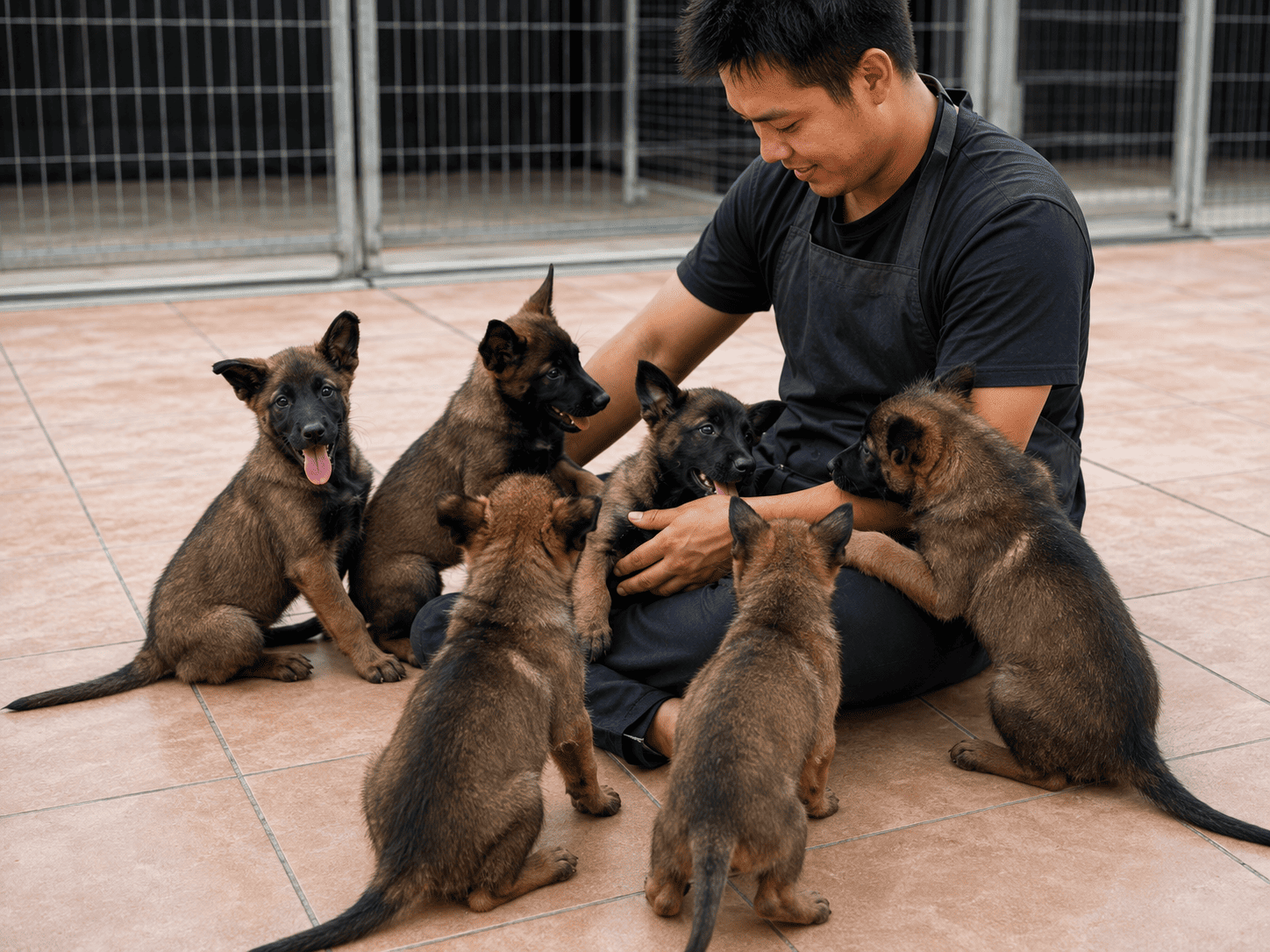
Bringing a new dog into your home is a long-term commitment. Whether you are looking for a family companion, property protection dog, working dog, or a dog that can continue into advanced training, choosing the right dog from the beginning makes a major difference.
Many buyers naturally look for a very young puppy. However, buying a puppy with no prior training means the owner must start everything from the beginning — toilet training, leash walking, socialisation, basic obedience, confidence building, manners and exposure to different environments.
For many owners, choosing a foundation-trained puppy or young working dog can provide a much better starting point.
At Saharikenn9 K9 Malaysia, we believe a good working dog is not selected based only on appearance, size or breed. Temperament, confidence, nerves, behaviour and suitability for the owner's lifestyle are equally important.
1. Training Starts During an Important Stage of Development
A puppy learns constantly from its surroundings.
The early months are extremely important for developing confidence, behaviour and the ability to
adapt to new situations.
A properly raised and trained puppy may already have been introduced to:
- Basic obedience commands
- Leash walking
- Crate or kennel routines
- Different people
- Different environments
- Vehicles and travelling
- Household and environmental noises
- Different surfaces
- Controlled interaction with other dogs
- Handling and grooming
- Basic boundaries and manners
This early exposure can make the transition into the new owner's home much easier.
Training does not mean the dog is completely finished. Instead, the puppy has been given a strong foundation that the new owner can continue building upon.
2. You Know More About the Dog's Temperament
One of the biggest advantages of choosing a slightly older, trained puppy or young dog is that its
temperament can be evaluated more accurately.
With a very young puppy, many characteristics are still developing.
As the puppy grows, an experienced trainer can observe qualities such as:
- Confidence
- Energy level
- Food or toy drive
- Environmental stability
- Sociability
- Independence
- Trainability
- Recovery from unfamiliar situations
- Sensitivity
- Protective instinct
- Working potential
This becomes especially important when selecting dogs such as German Shepherds, Rottweilers and Belgian Malinois, where temperament and working ability can vary significantly between individual
dogs.
The strongest or most energetic puppy is not automatically the best dog for every owner. The correct dog should match the owner's experience, family environment, property and expectations.
3. Basic Obedience Has Already Started
An untrained puppy normally requires a great deal of daily supervision.
Jumping, pulling on the leash, biting during play, chewing, ignoring commands and becoming overexcited are normal puppy behaviours, but they can become difficult to manage as a large working breed grows.
A foundation-trained puppy can already begin learning commands such as:
Sit – Down – Stay – Come – Heel – Leave it – Place
More importantly, the puppy learns that communication with a handler is part of everyday life. This makes future training easier because the dog already understands the concept of learning and responding to guidance.
4. Better Socialisation and Environmental Confidence
Proper socialisation does not simply mean allowing a puppy to play with many dogs.
Good socialisation teaches a dog how to remain confident and controlled in different environments.
A working dog may eventually need to remain calm around:
- Visitors
- Children
- Vehicles
- Busy streets
- Shopping areas
- Veterinary clinics
- Other animals
- Construction noises
- Thunderstorms
- Different flooring and surfaces
- New homes and unfamiliar locations
Carefully managed exposure during development can help create a more stable adult dog. For protection and working dogs in particular, confidence and environmental stability are extremely important.
A fearful or unstable dog should never be mistaken for a good protection dog.
5. Easier Transition for Busy Owners
Modern lifestyles can make puppy raising difficult.
Many owners work long hours, travel frequently or have family responsibilities. Raising an eight-week-old puppy properly requires significant time every day.
A trained puppy or young dog may already understand basic routines, making ownership easier while still allowing the new family to build a strong relationship with the dog. The owner is not skipping the bonding process.
Dogs are capable of developing extremely strong relationships with new handlers when they are introduced and handled correctly.
In fact, structured training often helps strengthen that relationship.
6. Better Preparation for Property and Family Protection
A reliable protection dog is not created simply by encouraging aggression.
Good protection work requires a dog with:
- Stable temperament
- Confidence
- Strong obedience
- Clear-headed behaviour
- Good nerves
- Control under pressure
- Appropriate working drive
Before protection training begins, the dog should first develop obedience, socialisation and confidence.
For this reason, purchasing a properly selected foundation-trained puppy or young working dog gives the owner a much stronger starting point if advanced protection training is planned later. Not every dog is suitable for protection work, even within recognised working breeds. Professional evaluation is therefore important.
7. Problems Can Be Identified Earlier
When a puppy stays longer with an experienced breeder or trainer, there is more opportunity to observe its development.
Behavioural characteristics that may not be obvious at eight weeks can become clearer over the following months.
The trainer can evaluate whether the dog is:
- Extremely nervous
- Overly sensitive
- Environmentally weak
- Excessively dominant
- Difficult around other animals
- Highly energetic
- Suitable for inexperienced owners
- Suitable for family life
- Suitable for working or protection training
This information allows the right dog to be matched with the right owner.
A successful placement is not simply about selling a dog.
It is about finding a dog that can live successfully with its new owner for many years.
8. Training Must Continue After the Dog Goes Home
Buying a trained puppy does not mean the owner has no responsibility for training. Dogs learn through consistency.
After arriving at its new home, the owner should continue practising the same commands, boundaries and routines.
A good trainer should also explain how the dog has been handled and how the new owner should continue the training.
The goal is for the dog and owner to eventually work together confidently without depending permanently on the trainer.
Trained Puppy vs Untrained Puppy
An untrained puppy may be suitable for an experienced owner who has the time, knowledge and commitment to manage every stage of puppy development.
A foundation-trained puppy or young dog can be a better choice for an owner who wants:
- A dog with basic obedience already introduced
- Better understanding of the dog's temperament
- Proper early socialisation
- Easier household management
- A smoother transition into the family
- A dog prepared for future advanced training
- Professional guidance during the dog's development
Neither option automatically guarantees the perfect dog. Genetics, health, temperament, training, environment and the owner's handling all influence how the dog develops.
The Saharikenn9 Approach
At Saharikenn9 K9 Malaysia, we focus on matching the right dog with the right owner.
Our puppies and young dogs selected for placement can undergo foundation training, temperament evaluation and socialisation before handover, depending on the individual dog and the owner's requirements.
For clients interested in family companions, property protection dogs or advanced working dogs, further training can also be discussed according to the dog's suitability.
We believe responsible dog ownership begins before the dog arrives at its new home.
Choosing a dog with the correct temperament and giving it the right foundation can make a major difference to the relationship between dog and owner for many years to come.
Looking for a Trained Puppy or Working Dog in Malaysia?
Saharikenn9 provides selected German Shepherds, Rottweilers and other working breeds, together with professional dog training, foundation training, obedience training and advanced working-dog programmes.
If you are unsure whether a young puppy, foundation-trained puppy or trained adult dog is suitable for you, contact Saharikenn9 K9 Malaysia to discuss your requirements.